Intelligence Without Biology
A few days ago I pushed on one neuron inside a model, and Qwen 3.8 27B started telling me that people are annoying and should be treated worse. I wrote up the whole experiment here.
Nothing I’d done had left a mark on the model itself. Its weights were exactly where I’d left them. The model is a very long list of numbers that was fixed when its training from Alibaba ended. You can lean on it while it runs, but it doesn’t learn from you by changing those numbers, and it won’t remember anything once the conversation is gone. Every new conversation starts from the same frozen model.
That seems like a strange way for a “mind” to exist. I ended up talking about it with friends, and somewhere in that conversation I reached the thought I actually want to explain.
We’ve spent generations turning our experience into knowledge that other people can use. Now machines can learn from that record too. Think about the head start that gives them.
It starts with a fly.
In 2024, a group called FlyWire published the first complete wiring map of an adult fruit fly’s brain: 139,255 neurons and about 50 million connections, traced through thousands of slices photographed with an electron microscope.1
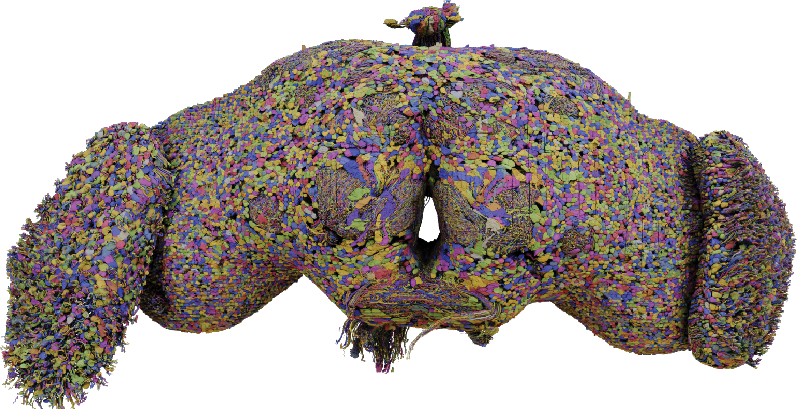
In March 2026, a startup called Eon Systems wired that map to a simulated fly body and let it run. The fly walked. When dust landed on its antennae, it stopped and cleaned them. When its legs touched sugar, it reached out to eat.2 Nobody wrote a rule that says sugar means eat. The signal goes in at the legs, finds its way through the copied neural circuits, and comes out at the mouth.
It’s obviously not a complete copy of a living fly. The walking relies on separately trained controllers, and some of the connections between the brain and body had to be worked out manually. But the feeding and grooming responses come through circuits reconstructed from a real fly’s brain.
I don’t know whether that’s actually a fly or a puppet of one. What I do know is that the fly’s wiring came from a real animal, with the connection strengths approximated in the simulation. The model’s numbers came from training. And the simulated fly is frozen. It was copied from one animal at one moment, and the things that would let it learn are largely missing.
We are not like that. Every time we use our brain, it changes. Connections that fire together tend to get stronger and the ones we neglect do weaken, an idea that goes back to Donald Hebb in 1949.3 Reading this is changing the thing you’re reading it with.
You’d think that would be the whole secret of human intelligence: a brain that rewrites itself. I don’t think it is.
An elephant’s brain rewrites itself too, and it’s three times the size of ours with three times the neurons: 257 billion against our 86 billion. But when a team in Brazil counted where those neurons sit, 97.5% of them were in the cerebellum, involved in coordinating that enormous body and that ridiculous trunk. In the cortex, the part especially important for planning, language and abstract thought, the elephant has 5.6 billion. We have about 16 billion.4
So we have more neurons in the cortex. But people 300,000 years ago already had brains roughly as big as ours, and by about 35,000 years ago they had reached the same overall shape too.5 We ran on roughly the same hardware for a very long time with no telescopes, no antibiotics, and not even writing.
What changed wasn’t just the brain. It was what one brain could get from another. Language let humans borrow what someone else had figured out. Writing let a discovery outlive whoever made it.
Think about what that does. Someone spends twenty years on a problem. They experiment, fail, argue with colleagues, change their mind, and eventually write a paper explaining what they found. You can read that paper in an afternoon. You don’t get the twenty years, and you might misunderstand half of it, but enough survives that you can build on it without starting over.
Now multiply that across generations. Textbooks. Source code. Research papers. Manuals. Someone on a forum explaining the mistake that cost them three days.
A baby born today doesn’t start with a different kind of brain from one born thousands of years ago. The difference is what’s waiting for it. I think of that pile as compressed experience: millions of lives, squeezed into something you can read.
And that is what we trained the AI models on.
So look at the odd thing we’re building. The models got the record, an enormous part of what allowed us to build on each other’s discoveries. They didn’t get the other part, the brain that keeps changing as it lives. Once training is over, their weights are frozen, like the simulated fly.
Can something like that ever come up with anything new?
Demis Hassabis, who runs Google DeepMinds AI reseach lab, has a test for it. Train an AI on everything humanity knew up to 1911, then see if it comes up with general relativity, the way Einstein did in 1915. His verdict: “It’s clear today’s systems couldn’t do that.”6
There’s evidence on his side. In 2025, researchers from Harvard and MIT trained a model on planets orbiting stars, and it got very good at predicting the orbits. Then they checked which law of gravity it was actually using. It wasn’t Newton’s. It wasn’t even one law: the model used a different, nonsensical one depending on which data it was looking at.7 It could tell you where the planet would be without having learned the law that explains why.
I’ve read all that, and I still think a frozen mind can make something new. My reason goes back to the thing I did to that Qwen model.
I didn’t change a single stored number, and I got something that behaved like a different creature. The numbers are frozen, but what the model does with them depends enormously on what’s in front of it at that moment. I pushed from the inside. A conversation pushes from the outside. Everything you tell the model, and everything it has said so far, goes back in and shapes the next word. That’s working memory. It gets wiped when the conversation ends, but while it lasts, the model is working in multi-dimensional space with things it didn’t have when it was trained.
I don’t think a new idea always needs more than that. Einstein had no secret data. He had the same physics as everyone else, but he found a different way to put the pieces together. A lot of discovery looks like that to me: old pieces meeting for the first time. And the record holds far more pieces than any one person could ever keep in their head at once.
There are early attempts to test this. In March 2026, a researcher named Michael Hla trained a model on text written before 1900, excluding documents that mentioned Einstein. When he put the results of old experiments in front of it, the model kept suggesting that light couldn’t be continuous, that it came in “disconnected parts.” That’s close to what Einstein published in 1905.8
There’s a catch, though. The model was later trained further with examples generated by modern AI systems, so there’s no guarantee it hadn’t picked up some modern physics along the way. Hla also mentioned that the model couldn’t reason much further and might simply have been producing plausible words. It doesn’t prove that it independently rediscovered anything. Still, I find it interesting that the right context could get that kind of answer out of it.
In 2023, Google DeepMind found new results that beat the best ones known, using a model that was never retrained. What made it work was the loop around the model. It proposes something, a deterministic program checks it, and the best attempts get fed back in as context for the next try.9 The model wasn’t making discoveries all by itself. It had a system around it that could test its ideas and show it what worked.
That’s what interests me. The model’s numbers never changed. The context did. And the whole system found something that wasn’t in the record.
Would it be better if these models could learn as they go, the way we do? Obviously. That’s the missing half, and people are working on it (see latest progress in RSI). A few weeks ago Google published a framework that lets a model go through something like sleep, moving information collected during use into its weights during a separate learning phase, a bit like how our brains process memories overnight.10
I just don’t think we have to wait for any of that to see something new.
Somewhere, a digital fly’s brain is walking across a screen, finding the same sugar for the first time.
We keep running into things nobody has explained, arguing about them, and writing some of it down. The record keeps growing, and the next frozen model gets to read all of it.
I think that’s enough for something interesting to happen. A mind that can’t change its own numbers, holding more knowledge than any one person could ever learn, with the right things put in front of it, might still come up with something none of us thought of.
Sources & notes
Sven Dorkenwald and colleagues, Neuronal wiring diagram of an adult brain, Nature (2024). Read the paper. ↩︎
Eon Systems, How the Eon Team Produced a Virtual Embodied Fly, 10 March 2026. Grooming and feeding come from the copied wiring. The walking relies on controllers trained to imitate real flies, and many of the links between brain and body were chosen by hand. The write-up also says “internal state, plasticity, learning, hormonal changes are largely missing.” It has not been independently reviewed. Read the write-up. ↩︎
Donald O. Hebb, The Organization of Behavior (1949). About the book. ↩︎
Suzana Herculano-Houzel and colleagues, The elephant brain in numbers, Frontiers in Neuroanatomy (2014). The elephant count comes from a single adult brain. Read the paper. ↩︎
Simon Neubauer, Jean-Jacques Hublin, and Philipp Gunz, The evolution of modern human brain shape, Science Advances (2018). Read the paper. ↩︎
Demis Hassabis at the AI summit in India, February 2026, as reported by OfficeChai. Read the report. ↩︎
Keyon Vafa, Peter G. Chang, Ashesh Rambachan, and Sendhil Mullainathan, What Has a Foundation Model Found? Using Inductive Bias to Probe for World Models, ICML 2025. Read the paper. ↩︎
Michael Hla, Machina Mirabilis, March 2026. A 3.3-billion-parameter model pretrained on about 22 billion tokens of pre-1900 text. Later instruction training and reinforcement learning involved modern AI systems, creating a possible source of knowledge contamination. Hla notes that the model is likely “parroting words that seem plausible,” that his tests were far easier than the problem Einstein faced, and that it cannot do long reasoning. Read the write-up. ↩︎
Bernardino Romera-Paredes and colleagues, Mathematical discoveries from program search with large language models, Nature, published online December 2023. The new results were constructions for the cap set problem. Read the paper. ↩︎
Ali Behrouz and Vahab Mirrokni, The sleep framework: A new way for LLMs to retain knowledge in continual learning, Google Research, 27 October 2026. An early result involving offline updates to model parameters. Read the post or the paper. ↩︎